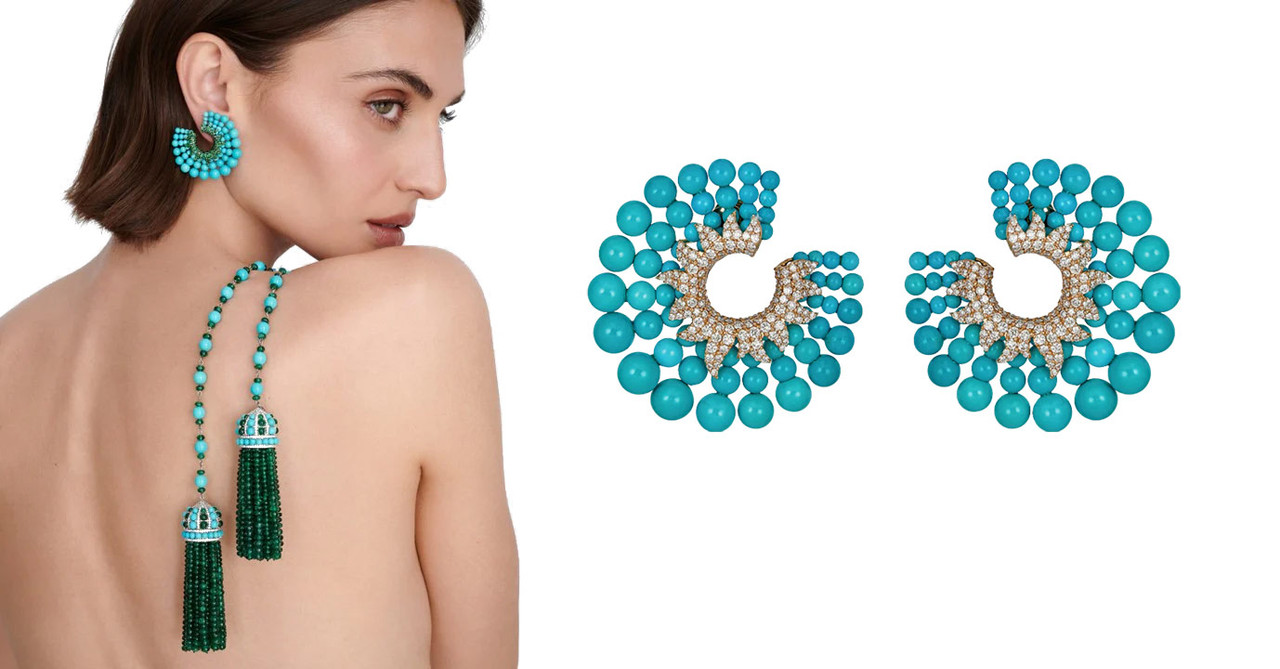
The growing demand for turquoise drop earrings has led to the production of inferior products. As such, many of those pieces sold as “turquoise” are actually dyed howlite, resin, or reconstructed stones designed to mimic the look of genuine turquoise.
Some fake stones are so well imitated that they look like the real deal at first glance. That’s why it matters that you understand gemstone quality before buying turquoise jewelry. Such knowledge will help you avoid overpriced imitations and better appreciate the craftsmanship behind genuine pieces.
Are you interested in vintage-inspired turquoise drop earrings, gold turquoise earrings, or luxurious designs featuring diamonds and natural stones? This article explores the difference between real and imitation turquoise. After reading, shopping will be much easier and more confident.
Understanding the Value of Turquoise
The finest turquoise is often described as “robin’s egg blue,” a color long associated with highly prized Persian turquoise. Although it’s not a sparkling gemstone, its smooth texture and sky-blue color are what catch the eye. The ones you see with rich blue-to-green hues are natural turquoise too, but they are usually considered less valuable by traditional gem standards.
Natural vs Stabilized vs Synthetic Turquoise
Natural turquoise is mined, cut, and polished with little or no treatment. The stone is a hydrated copper aluminum phosphate with the chemical formula CuAl₆(PO₄)₄(OH)₈·4H₂O. Copper produces the well-known blue color, while iron is responsible for the green tones.
Genuine turquoise usually has a Mohs hardness of 5–6 and a specific gravity between 2.6 and 2.9. High-quality natural stones are hard to find because many turquoise deposits produce soft, porous material. That’s why stabilized turquoise is common in jewelry these days.
Stabilized turquoise is still authentic turquoise, but it has been treated with resin or epoxy to increase its durability. This treatment protects the stone from cracking, discoloration, and other damage, even when worn daily. Treated turquoise remains original as long as the gemstone itself is genuine.
If you’re wondering, synthetic and imitation turquoise are not the same. Synthetic turquoise is lab-created to imitate the mineral’s chemistry and appearance. Meanwhile, imitation turquoise only copies the look and is often made from dyed howlite, magnesite, resin, or plastic.
Why Genuine Turquoise Is Rare
It’s becoming harder to find high-grade turquoise because many historic mines now produce only limited quantities. This rarity increases both the price and craftsmanship of luxury turquoise jewelry. Because of this, high-end turquoise drop earrings are often paired with luxurious materials and hand-crafted settings.
Key Signs of Authentic Turquoise Drop Earrings
It is difficult to imitate original turquoise perfectly because of its unique appearance. Although some imitation stones look convincing online or under bright store lighting, authentic turquoise often shows subtle natural details that fakes struggle to replicate. Let’s look into those small details.
Examine the Color Carefully
To identify real turquoise, closely examine its color. Natural turquoise rarely looks perfectly uniform because it forms under changing mineral conditions over long periods. Genuine stones often contain slight variations in tone, depth, and saturation, even within the same earring.
Authentic turquoise usually appears in shades such as sky blue, green-blue, and deep robin’s egg blue. If the color is too perfect, it could be a warning sign. Many imitation stones are manufactured to look flawless, which removes the natural variation found in genuine turquoise.
Dyed howlite and magnesite are among the most common turquoise substitutes on the jewelry market today. These stones are chemically different from turquoise but can resemble it once dyed bright blue. Excessively vivid or neon-blue tones are often signs of dyed or synthetic material rather than natural turquoise.
Check the Matrix Patterns
Matrix patterns are the dark veins or web-like markings that appear inside turquoise. These lines result from surrounding minerals and rock formations during the gemstone’s natural growth process.
Authentic spiderweb turquoise is highly valued for its distinctive, irregular, and natural veining patterns. Natural matrix lines usually look uneven, asymmetrical, and slightly random.
Fake matrix patterns usually look repetitive, printed or painted, extremely symmetrical, and too perfect. Also, if the stone looks glossy and has an artificial appearance that lacks the depth of real stone, it’s a plastic imitation.
Feel the Weight and Texture
Resin or plastic copies are not as dense as genuine turquoise. Minerals like actual turquoise usually feel cool to the touch at first, whereas lightweight fakes warm quickly when held.
Natural turquoise often has small imperfections, shallow pits, or an uneven texture. These subtle flaws are normal. However, smooth surfaces with a plastic-like finish indicate a synthetic material.
Inspect the Craftsmanship
Authentic turquoise earrings are often paired with quality materials such as sterling silver, 14K or 18K gold, diamonds, and other fine gemstones. These accessories often feature carved turquoise details paired with pavé diamond accents, enhancing the stone’s natural color and providing a striking contrast.
The setting itself also reveals a lot about quality. Fine turquoise jewelry commonly uses bezel settings that securely surround and protect the stone. If you notice poorly glued stones, uneven metalwork, or loose settings, that’s an indication that the jewelry is of lower-quality craftsmanship or is an imitation.
Since genuine turquoise is relatively rare, reputable jewelers often use stronger settings and higher-quality metals to reflect the gemstone’s value.
Common Types of Fake Turquoise Used in Jewelry
Some of these imitations are dyed, some are reconstituted, while some are just plastic. Take note of the clues that give them away so you don’t fall for fake imitations sold as genuine turquoise.
Dyed Howlite
Dyed howlite is one of the most common turquoise substitutes used in jewelry. Howlite is a naturally white or gray mineral with dark veins running through it. Once dyed blue, it can look surprisingly similar to turquoise.
The biggest clue is often the color itself. In dyed howlite, the blue dye may collect heavily along veins or tiny cracks, creating darker patches or uneven staining. Many dyed stones also appear brighter and more artificial than natural turquoise, especially under strong lighting.
Reconstituted Turquoise
Reconstituted turquoise is made from small turquoise fragments or powdered turquoise mixed with resin, glue, or plastic binders before being compressed into a solid shape. Because it contains real turquoise, it is not entirely fake.
However, it is generally considered less valuable than natural or stabilized turquoise because the stone has been heavily processed. Reconstituted turquoise is most likely to have an even color or pattern. Also, it may lack the depth and natural variation of higher-quality stones.
Plastic and Resin Imitations
Some turquoise imitations contain no real turquoise. These pieces are simply plastic or resin colored to imitate the gemstone’s famous blue-green shades.
Plastic and resin copies are usually lightweight, overly smooth, and warmer to the touch than genuine turquoise. They may also have an unnaturally glossy finish or printed-looking matrix patterns that are nothing like real mineral veining.
Although these imitations can look attractive in inexpensive fashion jewelry, they lack the natural mineral composition, rarity, and value of authentic turquoise.
How to Test Turquoise Without Damaging It
Many people make the mistake of using harsh scratch tests or aggressive chemicals on valuable turquoise gemstone jewelry, which could cause permanent damage. Don’t follow the multitude; learn safer ways to verify turquoise authenticity.
The Magnification Test
One of the safest methods is to use a jeweler’s loupe or a small magnifying glass. Under magnification, authentic turquoise often shows tiny pores, uneven mineral texture, and naturally irregular matrix patterns.
This closer view can also reveal dyed stones. Printed or fake matrix lines may also appear too repetitive or perfectly shaped under magnification.
Professional Gemstone Certification
If you’re dealing with high-value turquoise jewelry, professional certification is often the safest and most reliable option. Gemological labs can determine if the stone is natural, stabilized, synthetic, or heavily treated without damaging the jewelry itself.
Certification becomes especially worthwhile for turquoise pieces set in 14K or 18K gold, diamonds, or luxury handcrafted settings. It also provides added confidence when buying collectible or investment-grade turquoise jewelry.
Final Thoughts
You can usually identify authentic turquoise drop earrings by their natural color variation, irregular matrix patterns, distinctive texture, and quality craftsmanship. Genuine turquoise rarely looks perfectly uniform, which is why slight differences in tone and veining are often good signs.
Also, real turquoise is commonly paired with sterling silver, gold, and diamonds, and is set in secure bezel settings, as valuable stones require stronger craftsmanship and protection.
Transparency is equally important when buying turquoise jewelry. Reputable sellers normally disclose if the stone is natural, stabilized, or treated. Understanding these details protects you from imitation stones and financial mistakes.
Authentic turquoise jewelry is valuable because of its natural formation and craftsmanship. Each stone develops unique colors and patterns over time, which makes every pair of turquoise drop earrings slightly different. So you get natural beauty and individuality in one piece.